
Newsletter • Quarter 4 • 2022
Portfolio Performance
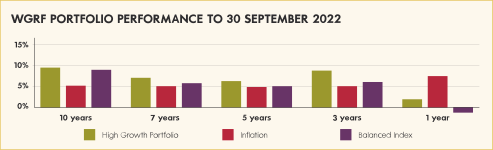
Therefore, on the chart above, we intentionally show the 10-year returns first, as the long term is where your focus should be when looking at the investment performance of your retirement savings.
Over the short term, such as the one-year period, investment returns may be more volatile, going up or down more often, as they are driven by current events, supply and demand factors and the 'noise' in investment markets. 'Noise' refers to the day-to-day flow of news and activity (both globally and locally) that affects investment market returns over brief periods. These events are virtually impossible to predict, and often do not give a good picture of how the market will perform over the long term.

Long-term results are beating inflation
Over the long term (10 years or more) the Fund has comfortably earned an investment return higher than inflation. Inflation is one of the biggest risks you face in saving for your retirement, as it erodes the purchasing power of your savings over time. Over the long term, your savings therefore need to grow by an investment return that is higher than inflation.
In the one year returns on the right of the chart above, you can see the spike in inflation that is being experienced worldwide. The war in Ukraine as well as the economic recovery after the Covid pandemic are largely responsible for the spike in global inflation. The uncertainty created by these unexpected events has had a significant impact on investment markets, making short-term returns (six years and less) even more unpredictable than usual.
As a member of the Woolworths Group Retirement Fund, you have these benefits:
Never cash out your retirement savings – stay invested

Understanding poor performance
Here we look at why an asset manager may perform poorly. Understandably, you may be concerned when they underperform while managing the Fund’s assets.
By 'underperform' we mean that one or more of the following has happened:
The Fund has intentionally designed its investment strategy so that it can appoint asset managers with different investment styles and approaches. This is a way of managing risk. It does, however, mean that there will sometimes be an asset manager that is underperforming. The idea is to avoid all the appointed asset managers underperforming at once, or the same asset manager consistently underperforming.
Essentially, there are four main explanations for an asset manager's poor performance:
The asset manager has made poor investment decisions. These are often just a mistake, but the manager remains skilful. Remember that investment outcomes depend on an unknown future and occasionally getting it wrong is inevitable.
The asset manager has made good decisions, but some event that could not have been anticipated causes a poor outcome.
The asset manager has made the right decision, but the timing was wrong – this normally shows after a long time has passed.
The asset manager has shown poor skills. This is the most difficult to identify and of the most concern. If the poor performance is due to their poor skills, then the asset manager’s appointment must be reviewed.

The Trustees carefully monitor the Fund’s asset managers
The Trustees have appointed expert investment consultants to assist with monitoring and managing the performance of the asset managers. The Trustees take this responsibility seriously and engage with the asset managers if there is any sign of a problem.
The asset managers are not simply appointed and then left to manage the Fund’s assets without oversight. Nor are the asset managers changed in a knee-jerk reaction to short-term performance issues. The Trustees carefully monitor and evaluate the Fund’s asset managers and their performance with the support of the Fund’s investment consultants.