
Newsletter • Quarter 3 • 2024
Portfolio Performance
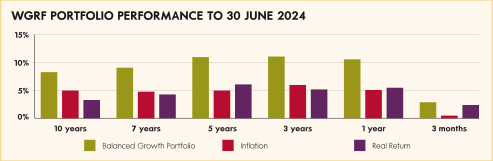
Building your retirement savings takes time and patience
Unless you are close to retirement (age 60 or older), saving for your retirement is a long-term exercise. This is why we show the Fund's 10-year returns first. When looking at the investment performance of your retirement savings, your focus should be on the long term.
Over the long term (seven years or more), the Balanced Growth Portfolio has earned an investment return higher than inflation, but has missed the 5.5% target. The main reason for missing this target has been the underwhelming performance of South African equities. Shorter-term investments, up to five years, have delivered stronger real returns. However, you should not focus too much attention on these outcomes, as these returns could just as easily have been poor.
In the short term, markets react to events, supply and demand factors, and the news flow in investment markets, often referred to as ‘noise’. These day-to-day changes are unpredictable, as is their impact on market performance. Since these short-term factors do not offer a clear view of how the market will behave over time, we cannot rely on them to make sound investment decisions.
Focusing on long-term trends provides a better perspective for understanding market performance and for planning investments.

An example of the long-term performance of investment returns
- Here is an interesting fact to consider – in any given year, there is a 64% chance that the S&P 500 (an index of the largest 500 companies in the USA) will decline by 10% or more. These drops, though often short-lived, cause anxiety for many investors.
- However, over the past 50 years, the index has still delivered an impressive average return of 11.75% per year in US dollars.
- For example, if you had invested $100 in the S&P 500 on 1 July 1974, it would have grown to $25 852 by 30 June 2024.
- Here is another interesting point – back in 1974, you only needed R68.04 to buy $100. That same R68.04 would now be worth around R472 000 today, despite the market dropping by at least 10% in 32 of those 50 years. This shows the power of long-term investment in the USA.
- The US stock market has delivered strong returns over the past 50 years, but the principle that markets often drop and then recover to give good returns over time, applies to many markets worldwide.
- Whenever the markets fall sharply, the media tries to explain why this has happened. But there is a simple truth – no one truly understands how markets work. With thousands of people and institutions making decisions based on constantly changing information, it is impossible to predict exactly what will happen next.
Some guidelines to keep in mind for a long-term approach
Steady and consistent
Market resilience
- The wealthiest economies in the world have the most resilient markets.
- South Africa has a more fragile economy, so it does not have such resilient markets.
- Exchange control legislation limits the amount of money you can invest outside South Africa to 45% of your retirement savings.
- Ideally, you would want to invest more of your retirement savings in more resilient markets.
- However, about 65% of the earnings of the companies listed on the FTSE/JSE stock exchange are generated offshore. This means that your money does actually have more offshore exposure.

Where does this leave your retirement savings?
It is comforting to know that the Board of the Woolworths Group Retirement Fund put much effort into constructing investment portfolios designed to be resilient and ensuring the portfolios are diversified.
The Board and its Investment Committee have a solid process for determining the Fund’s investment strategy. This should lead to better returns over long periods (but it cannot be guaranteed).
Read more about the do's and don’ts of investment switching.